Tip for English language learners: You can listen to the chapter audio while reading the story text on the page. Try slowing the playback speed so you can follow along comfortably by clicking on the three dots on the right by the speaker and selecting Playback speed.
The wind had a thin edge to it that afternoon, the kind that slipped through seams and made a man think winter was comin’ back. Jake Harmon stood by the feed shed, eyes moving from bin to bin, counting bushels by habit more than need. He already knew the numbers. He just didn’t know what to do with them.
Mary came up beside him, shawl pulled close, eyes following his without pressing. Down near the bunkhouse, Eli was mending a torn cinch with wire he’d straightened and saved, again. Boone lay nearby, head on his paws, watching the world with the quiet trust of a dog who believed things would work out. “We’ve got enough,” Jake said finally. It wasn’t a statement of fact so much as a question aimed at the wind.
Mary nodded. “Enough for us.” Jake exhaled. “That’s the trouble.”
Earlier that day, a traveler had stopped at the ranch, an older man, coat worn thin, voice polite but tired. He hadn’t asked outright. Just mentioned the settlement downriver, families short on food after the floods. Jake had listened, thanked him, and watched him ride on.
Now the words sat heavier than the wooden bins lining the shed.
Eli tied off the wire and stood. “I heard him,” he said quietly. “About the families.”
Jake looked over. “You did.”
Eli hesitated. “If it were me… I’d be grateful someone noticed.” No accusation. Just truth.
They stood together on the porch and watched the river cut silver through the land. Mary rested her hands on the rail. “Do you remember what Pastor Kendall said last Sunday?” she asked. “About riches?”
Jake smiled faintly, “Hard to forget when a man’s been counting bushels all week. Caldwell told me we had enough, but I had to prove it to myself.”
“Pastor said the richest thing Christ ever owned,” Mary continued, “wasn’t gold or land. It was glory. And He let it go when He came into this world.”
“Doesn’t make sense to most people,” Eli said, “Why He’d give up everything, but He did it for us.”
Mary looked at him, “They don’t realize it, but God doesn’t measure the cost of love the way we do.”
Jake felt something settle in him, not relief, but clarity. He thought of a Shepherd walking dusty hills with nothing but a staff and a voice the sheep trusted. He thought of heaven traded for hunger, strength laid down willingly.
“He didn’t come poor so we’d get rich in coin,” Jake said slowly. “He came poor so we’d know what true riches really are.”
They stood there a while. Boone rose and pressed against Eli’s leg, tail thumping once.
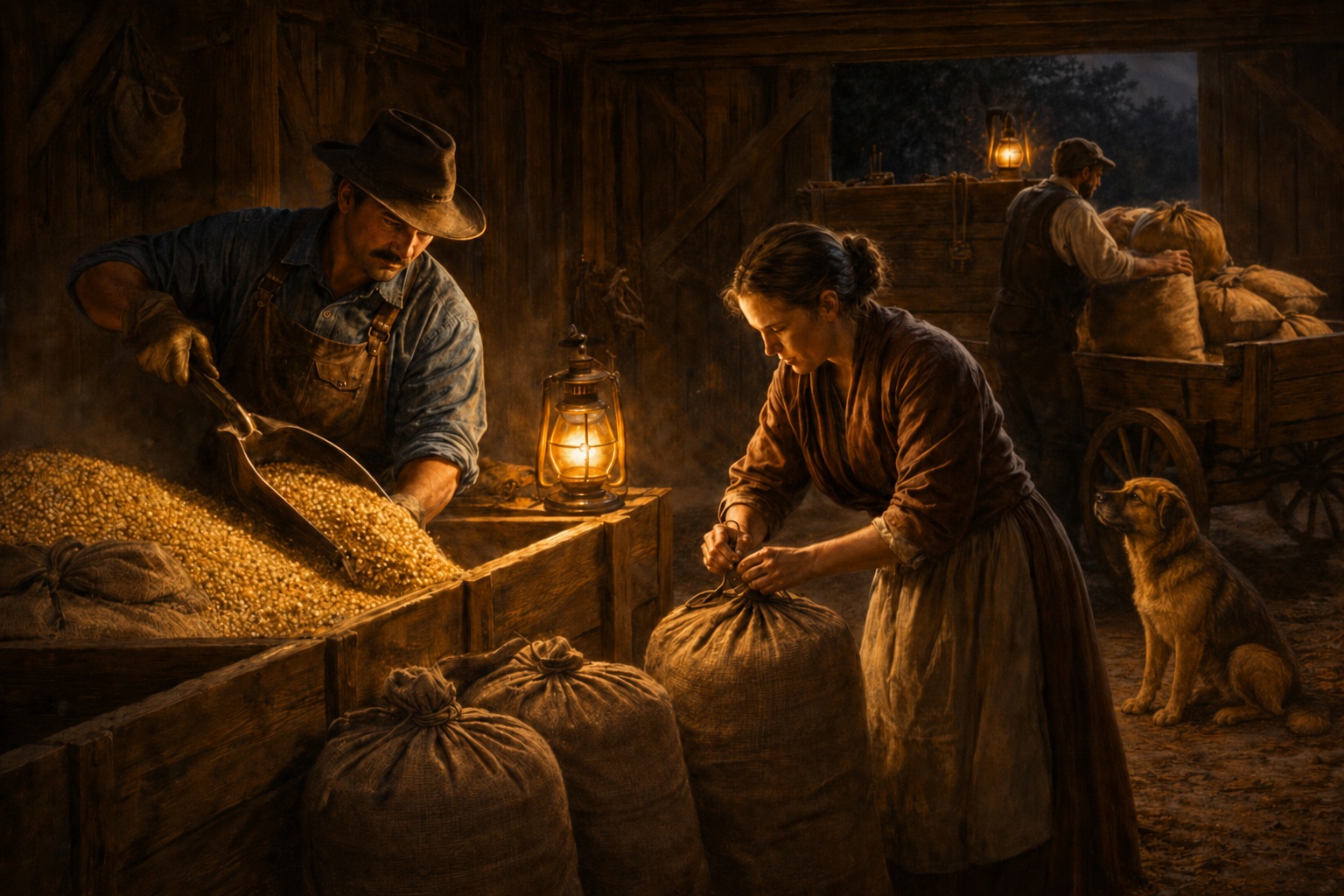
That evening, they worked by lamplight, shoveling grain from the bins into burlap sacks and tying each one off carefully.
Just steady hands and quiet resolve.
They drove their loaded buckboard downriver at first light. No speeches. No pride in it. Just steady wheels rolling toward need.
When they returned, the feed shed looked thinner. The bins Jake had counted were lower now. But as Mary poured coffee, Eli fed Boone, and they sat down to eat, the ranch felt fuller than it had all week.
Looking out the window, Jake watched the sun continue its steady climb and understood something he’d missed before. Riches weren’t what he could hold onto. Riches were what he could give without fear, because grace had already given him more than enough.
He said quietly, “Now I know how Caldwell measures enough. We have enough to share with those who don’t.”