Tip for English language learners: You can listen to the chapter audio while reading the story text on the page. Try slowing the playback speed so you can follow along comfortably by clicking on the three dots on the right by the speaker and selecting Playback speed.
The bunkhouse was full of the ordinary sounds of evening at Roaring Rapids Ranch: boots thudding onto the floor, the creak of leather being hung on pegs, low voices drifting like smoke through the lamplight.
Matt Martin sat near the end of the long table, slowly finishing his coffee before Tiny served supper. His shoulders ached from a full day mending fence along the north pasture, and he had not yet taken his coat off. Across the room, Hank Dobbs had already begun.
“Wind’s comin’ up again,” Hank muttered, staring into his tin cup. “Blow ice right into your teeth tomorrow, you watch. And that north fence won’t hold through another hard storm. We’ll be out there fixin’ it all over again.”
One of the hands shrugged. “That’s ranch work.”
Hank snorted. “Don’t mean I gotta like it.”
He took another sip and grimaced. “Coffee’s weak tonight too.”
A couple of men chuckled softly, used to Hank’s constant commentary, but Matt felt a familiar heaviness settle in his chest.
It wasn’t just Hank. It seemed like every evening brought some kind of grumbling. If it wasn’t the weather, it was the work. If it wasn’t the work, it was the hours, the food, or the cattle.
At first Matt had barely noticed it. Now it felt like a steady drumbeat in his mind.
And what troubled him most was this: lately he had caught himself doing the same thing.
Not out loud much, but inside.
Earlier that afternoon, when the wind picked up and blew snow into his eyes, he had thought, Why’s it always gotta be like this? When the bell rang before sunrise that morning, he had groaned under his breath.
Sitting there now, listening to Hank complain about the cold creeping into the nights, Matt realized something that unsettled him.
The complaining didn’t just stay in the room. It followed him. It colored how he saw the work, the weather, and even the good parts of the day.
He set his cup down quietly.
This ain’t the way I want to think, he told himself.
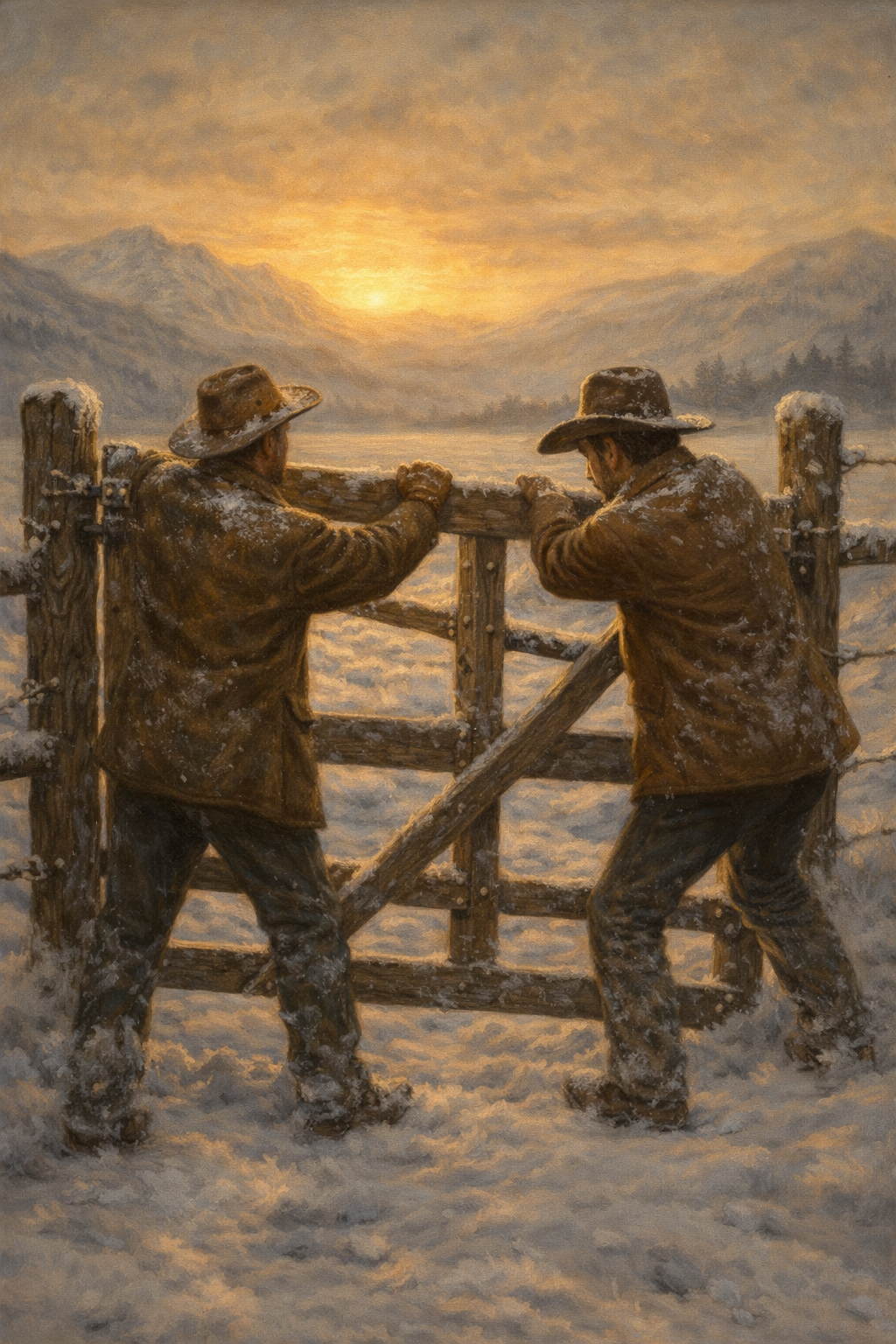
Before dawn the next morning, Matt found Jake Harmon near the barn, tightening a saddle cinch by lantern light. The air was sharp and cold, and the snow lay white along the fence rails.
Jake glanced up. “Mornin’, Matt.”
“Mornin’.”
Matt hesitated, then stepped closer. “Jake… can I ask you something?”
Jake nodded easily. “Go ahead.”
Matt rubbed his hands together against the cold, then pulled on his gloves.
“It’s about the bunkhouse,” he said. “There’s a lot of complaining. Seems like every night someone’s got something wrong with the weather, the work, or how things are done.”
Jake gave a faint smile. “Sounds about like most bunkhouses I’ve known.”
Matt didn’t smile back.
“It gets into your head,” he admitted. “I find myself thinking the same way sometimes. I catch myself complaining too, even when I don’t want to.”
He looked directly at Jake.
“How come I’ve never heard you complain? Not once?”
Jake was quiet for a moment, then leaned back against the rail.
"Let me tell you something my papa told me years ago,” he said.
Matt listened closely.
“He said a complaining man is like someone carryin’ a sack of burrs on his back. Every step he takes, those burrs rub and scratch. After a while he’s sore all over.”
Jake brushed some snow off his sleeve.
“The strange part is, he don’t have to carry that sack. But he keeps pickin’ it up anyway.”
Matt nodded slowly.
Jake continued, “Complaining spreads too. You sit near it long enough, and before you know it, you’ve got burrs stuck to your own coat.”
Matt let out a quiet breath. “That’s exactly how it feels.”
Jake looked toward the faint glow beginning in the east.
“Here’s the truth, Matt,” he said. “There’s a lot in this life you can’t change. Weather’s one of ‘em. So is hard work. So are early mornings.”
Matt followed his gaze toward the horizon.
Jake went on gently, “You can’t stop the wind from blowin’ or the snow from snowin’. But you can choose whether you spend your strength complainin’ about it or preparin’ for it.”
Those words settled deep inside Matt.
He thought about the long fence lines, the dust storms, the rain storms, the cold mornings, the walking on ice, the endless chores.
He’s right, Matt realized. I can’t change the weather. But I can change what I do about it.
Jake rested a hand briefly on Matt’s shoulder.
“You choose what you carry, son,” he said quietly. “You can carry the burrs, or you can carry the blessings. But you can’t carry both without feelin’ the weight.”
Matt nodded.
“I reckon I’d rather carry the blessings.”
Jake smiled. “That’s a load that won’t wear you out. Let me tell you a secret. Every time I want to complain or hear someone else complain, I think of one of my blessings or I remember something that happened recently that was a real blessing. That helps me replace a burr for a blessing.”
That evening in the bunkhouse, Hank Dobbs started in again.
“Wind’s comin’ stronger and more snow tomorrow,” he said. “Gonna be a miserable day to work.”
Matt listened for a moment, then quietly began oiling his saddle leather instead of answering.
I can’t change the weather, he reminded himself. But I can choose how I meet it. I’ve got a warm coat with buttons, I’ll have a hot breakfast, then good, honest ranch work. I’m thankful.
And when Matt finally lay down to sleep, he felt no burrs at all; only the quiet peace of a lighter load.